Showing posts with label Grades. Show all posts
Is Looking at GPA Lazy HR? The Role of Grade Inflation
by Matthew Stollak on Wednesday, August 27, 2014
As a professor, I am vigilant in examining my grading practices to ensure students are receiving a fair and deserved grade. I want to ensure that the grade reflects the work and performance a student demonstrated over the course of a semester. Last semester, I taught two sections of the same course - one section earned an average grade of 3.12 (on a 4.0 scale), the other a 2.67.
Unfortunately, grade inflation has been a major problem at many colleges and universities. As Libby Nelson at Vox.com notes:
By 2007, 83 percent of all grades at a sample of 200 four-year colleges and universities were A's and B's. And research from a former Duke University professor found that A's have been the most commonly awarded grade at four-year colleges since the 1990s:
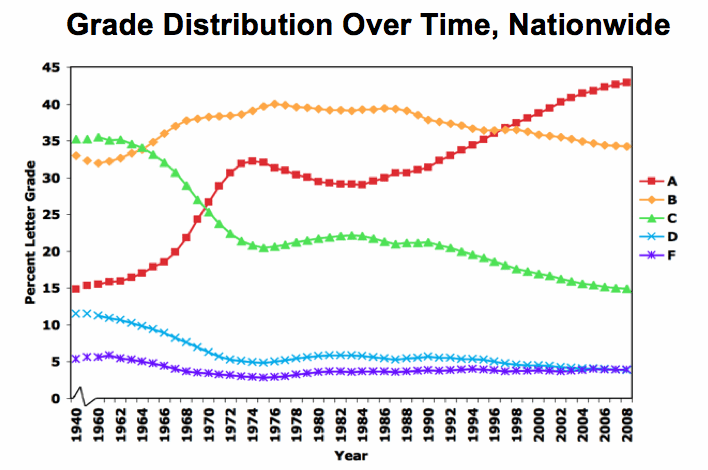
One school, Wellesley College, attempted to combat grade inflation by enforcing an average grade for an introductory class: a B+. If a faculty member exceeded this grade, he or she had to explain, in writing, why the higher grade was justified.
What was the impact of such a policy shift? Research by Kristin F. Butcher, Patrick J. McEwan, and Akila
Weerapana in the Journal of Economic Perspectives
found that results were immediate; average grades were brought down in previously high-grading departments.
Further, not only did it impact choice of major, but evaluation of teachers; with tougher grades, teachers received lower ratings...SHOCKING!
However, where HR should take note is how GPA is used for hiring decisions. Wellesley students were obviously concerned that lower grades would impact hireability, particularly if they were the only college instituting such a change. As Butcher, et al, note:
"They point to examples of web-based job application systems that will not let them proceed if their GPA is below a 3.5," the authors wrote. "The economist's answer that firms relying on poor information to hire are likely to fare poorly and to be poor employers in the long run proves remarkably uncomforting to undergraduates."
In the absence of other universities replicating Wellesley en masse, is using GPA as a criterion for hiring lazy HR? Do firms have evidence that the higher GPA is not only necessary for the job being performed, but distinguishes good performers from poor performers? Further, if all colleges (other than Wellesley) engage in grade inflation, is the GPA really meaningful for hiring purposes?
- One comment • Category: grade inflation, Grades, hiring
- Share on Twitter, Facebook, Delicious, Digg, Reddit


 In my efforts as professor, I have always been interested in the effect altering class policies and changing incentives has on student behavior. I fiddle around with changing attendance policies, the grading scale, the number of exams, the point values of exams to see the impact on how students approach the class.
For the past few semesters in the statistics class I teach, I've asked students to fill out a survey telling me things such as the name they liked to be called, their e-mail, etc. One question I've asked recently is "what specific goal is your grade for the class?" Assuming that students are not exactly thrilled about taking the subject, and assuming the students have the foresight to know it is a tough subject, I've expected an array of answers crossing the spectrum of the grading scale. However, the Lake Wobegon effect has held true, and the students have responded with very high opinions of themselves. Last semester, some 65 students answered, on average, a goal of 3.77 on a 4.0 scale (while the final average grade was a 2.77....I'm sure there were quite a few disappointed souls).
This semester is no different. Once again, the average grade goal was 3.77. In one section 23 (of 31) students had an A for their goal, with another 4 stating an "AB." In the second section, 18 (of 28) listed an "A" as their goal with another 8 listing an "AB." Only one student across two sections listed a grade below a "B."
I added a new question this semester, asking students, "What specific grade do you expect to receive in this class?" immediately after the question about their grade goal. Were students confident in their stated goal, or did they have high aspirations, but knew they realistically might not achieve them? 86% (51 out of 59) thought they would receive the grade they set as a goal.
So, the results beg a number of questions:
1. Is there a student grapevine? When I was choosing classes as an undergraduate, I would ask around about which professor to take, and how difficult he or she might be. Whenever I return exams, students always compare their scores to the person next to them. Are students sharing this information outside of the classroom as well? Do students really know how difficult the class might be?
2. Should we be managing expectations of students? Should I publish the average grade of previous semesters in my syllabi each semester, so that students know what grade they are likely to earn? Should the average grade be published when students register for classes (along with teacher ratings)? What other efforts should be made to temper student expectations?
3. What role does external or internal locus of control play?
I'm sure there is a study in here somewhere.
- One comment • Category: goal setting, Grades, performance
- Share on Twitter, Facebook, Delicious, Digg, Reddit
The use of social media sites, such as Twitter and Facebook, in the classroom is growing, as is student time spent on exploring such sites. However, little research has been done to examine the impact on grades. Does actively participating in social media (Facebook, Twitter, MySpace, blogs, YouTube, etc.) impact one's academic performance? Is social media usage impacted by the ownership of smart phones?
This fall, a colleague, two students, and I attempted to answer these questions. An online questionnaire asking students about social media, and its usage, was sent by e-mail to all students (approximately 2,100) at a small, liberal arts college.
The following hypotheses were posed:
Hypothesis 1a: Students with smart phones are more likely to be involved with social networking than students without smart phones.
Hypothesis 1b: Students with smart phones will spend a longer amount of time on social networking than students without smart phones
Hypothesis 2: Social media use will differ based on class standing.
Hypothesis 3: Social Science majors will utilize social media more than Natural Science or Humanities and Fine Arts majors
Hypothesis 4: A negative relationship exists between social media use and grade point average.
What did we find?
Of the approximately 2,100 surveys sent, 430 were received (20.47%). The primary respondents were freshman (42.5%) followed by sophomores (21.6%), seniors (19.8%) and juniors (14.8%). Gender was queried, but more than two-thirds (69.6%) chose not to answer. A significant majority (83.4%) had a grade point average (GPA) above 3.00, with 45.1% self-reporting a GPA above 3.50, 38.3% with a GPA between 3.00 and 3.50, 13.3% between 2.50 and 3.00, 2.7% between 2.00 and 2.5, and 0.5% below 2.00.
31.7% of students were able to access at least one networking site on their phone, with 98.5% able to access Facebook, 72.7% able to access YouTube, 58.3% able to access Twitter, 49.2% able to access MySpace, 45.5% able to access blogs, and 34.8% able to access LinkedIn.
Of the 430 respondents, 97% use one or more of the following social networking sites: Twitter, YouTube, blogs, Facebook, LinkedIn, or MySpace. The largest percentage of respondents used Facebook (95.4%), followed by YouTube (90.7%), reading blogs (27.6%), Twitter (17.6%), LinkedIn (7.2%) and MySpace (3.9%). Given the small sample size for MySpace, we chose not to include it in our analysis.
The time spent on the social networking sites echoed the order listed above, with 78.3 % indicating they spent the most time on Facebook, followed by YouTube (58.4% ranked it 2nd), reading blogs (41.7% ranked it third), Twitter (26.3 % ranked it fourth), and LinkedIn (43.0 % ranked it last).
How much time do students spent on social networking sites? Students, for the most part, spend less than 15 minutes a day on most social media sites. However, Facebook is the exception. A significant majority of students (77.2%) spend more than 30 minutes a day on Facebook.
FINDINGS
There was general support for hypotheses 1a and 1b. Students who have smart phones were more likely to both access social media tools and spend time engaging with others. From an educational standpoint, this means there may very well be a “digital divide” between those who are making connections with others, and those who might be left behind. Similarly, professors may have to be wary of assigning projects involving social media to students as some may have an advantage in completing the work than others.
There was partial support for hypothesis 2. Juniors and seniors were more likely to use Twitter and LinkedIn, and read blogs, then their younger colleagues. However, other than Facebook, there was no significant difference in the amount of time spent accessing these sites. As expected tools such as Twitter and LinkedIn have more relevance to older students as they try to connect with others in their job search or find work. Similarly, perhaps younger students use Facebook longer as they are building their social connections, whereas older students already have a well-established network of friends and colleagues.
There was also minor support for hypothesis 3. Social science majors were more likely to use LinkedIn and spend more time on Facebook. However, it was the Humanities and Fine Arts majors who were more likely to use Twitter and read blogs. Perhaps the difference lies in the emphasis placed on the written word, and Tweeting and reading blogs has more appeal to this group.
Finally, there was little support for hypothesis 4. GPA did not play a role in the use of any of the major social networking tools, and minutes spent on several of the sites did not differ. The major difference lay in time spent with Facebook, which did show a negative relationship between time spent on the social network and one’s grades. As noted in table 1, while most students spent 15 minutes or less accessing that particular tool, Facebook was the only social networking site where a majority of students spent more than 30 minutes of their time accessing. Students and teachers should be concerned about its impact on learning.