Showing posts with label Izzo. Show all posts

Over the past several days, you have seen 152,467 blog posts on Greg Smith's op-ed in the New York Times bemoaning the culture that had befallen Goldman-Sachs. I'd much rather look at another, more positive culture - no, not Zappo's or Southwest - it's Michigan State basketball under Tom Izzo, yet again.
Over the past 15 years, MSU has reached the Sweet 16 in the NCAA Tournament 10 times, with a possible 7th trip to the Final Four this year in that same time period. One of the primary reasons for the success is predicated on a particular system that is adopted throughout the institution:
“We just have a system down, and we use the same system but we tweak it here and there,” said Izzo, who breaks down film more like a football coach than a typical basketball coach. “I have a real confident belief that if we win the first game, that’s what I tell them: ‘You win the first game, I’ll get you through the second.’”This devotion can be seen by some of the least appreciated members of the team - the student members. Within minutes of the completion of the Big Ten Tournament, the student managers were in a van driving back to East Lansing to start putting together film of the opponents in the first weekend of the tournament for the coaches and players to watch:
Towels, water, errands and all the traditional manager duties are involved. But MSU also counts on its managers to record and dissect games of potential opponents — breaking them up into categories such as zone defense, man defense, made 2-pointers, missed 3-pointers, etc., and handing them off to (MSU Video Coordinator Jordan) Ott and the coaches for analysis.After the victory on Thursday night over LIU-Brooklyn, a similar process began:
While MSU’s coaches and primary players showered and prepared for media obligations, the team’s student managers created a basketball half-court in one of the Renaissance Downtown’s meeting rooms with duct tape. Assistant video manager and former Sexton head coach Doug Herner paced out the measurements, and a 3-point line, foul line, baseline and sidelines appeared on the carpeted floor.
By the time Tom Izzo and his team arrived around 12:45, the walk-ons were ready to rehearse several plays of the Saint Louis offense at walking speed, with the regulars going through their defensive assignments. Then it was 1:15, bed time for the players and time for the coaches to really dig into some strategic nuances that might push No. 1 seed MSU (28-7) past No. 9 seed Saint Louis (26-7) in today’s NCAA Tournament third-round game at Nationwide Arena.
Finding individuals who are willing to take on this 40 hour a week task (plus extra during the postseason) at no pay is critical
Ott takes a month each fall to decide on his hires, for jobs that are not advertised. He wants people who are trustworthy, enthusiastic and hard-working. Love for basketball is a must.However, there are long-term payoffs - full time positions elsewhere:
When Auburn had a video opening a few years ago, its people called (MSU's Director of Basketball Operations Kevin) Pauga and asked which MSU managers didn't have jobs.The real kicker in this story is this...not only did current managers work on prepping the some 17 games of video they had on LIU-Brooklyn prior to last Thursday's match-up:
"That became their entire candidate pool," he said.
"The biggest compliment to those guys," MSU assistant coach Mike Garland said, is that when an NBA or college team has an opening, they always call MSU first. 'Who you got?'"
Some former managers even stopped by to help them start finding and logging game film into MSU’s computer system as soon as LIU-Brooklyn was announced as the Spartans’ first opponent.Former employees...coming back...and helping...at no pay.
How many of your organizations can say they have alumni return to your place of employment to help out?
That's a true mark of a successful culture!
Its mid-March...one of my favorite times of the year. Why? It means the Men's Division I NCAA basketball tournament, aka "March Madness" is about to begin. As a graduate of Michigan State University, how could I not love it? Over the past 14 years, Coach Tom Izzo has led the Spartans to 6 Final Fours and a National Championship. This year looks promising for the Spartans as well, earning a number one seed in the tournament...which usually means success, as Izzo has made it to the Final Four three previous times as a number one seed.
One of my favorite metrics for the tournament (as well as filling out those darned brackets for the office pool) was coined by Pete Tiernan at CBS Sports - "Performance Against Seed Expectations" or PASE - which compares a coach's actual winning record to his expected performance based on seeding. According to Tiernan:
PASE is a simple concept. Every seed has recorded an average number of wins per tourney in the modern era. The average top seed wins 3.37 games per dance, two seeds win 2.43 (almost one game less), three seeds win 1.86 and so on. When the coach of a top-seeded team wins four games to reach the Final Four, he overperforms by .63 games. If he wins the championship, he exceeds seed expectations by 2.63 games.By adding up a coach's year-by-year performance, one can come up with the average games per tourney he deviated from the expected victory total. Associated with PASE, is what Tiernan calls "Seed Overachievement Rate," or "SOAR, which simply takes the number of times a coach has exceeded seed expectations out of the number of appearances.
So, who are the coaches that consistently outperform what they were expected to do?
Not surprisingly, Izzo leads the way. Based on seeding, his Spartan teams should've won 22.3 games in 14 tournament appearances. However, with Izzo's teams averaging about a 5 seed in the tournament (5.21), yet he has won 12.726 more games than what his seed should dictate, for a PASE of .909 (12.726/14); in essence, one should count on an Izzo team to win nearly one more game than the seed he is given. Similarly, Izzo's teams have outperformed their seed 10 times in those 14 appearances for a SOAR of 71.4% With a minimum of 5 tourney appearances, other coaches in this year's tournament who might carry one farther than expected:
*John Beilein of Michigan with a PASE of .705 and SOAR of 83.3%
*Steve Fisher of San Diego State with a PASE of .610 and SOAR of 36.4%
*Billy Donovan of Florida with a PASE of .563 and SOAR of 45.5%
*Jim Calhoun of UConn with a PASE of .493 and SOAR of 52.6%
*Rick Pitino of Louisville with a PASE of .466 and a SOAR of 46.7%
*Coach K of Duke with a PASE of .426 and a SOAR of 50.0%
Of course, there are those coaches who will let you down every year. Who consistently underperforms?
DePaul coach Oliver Purnell has consistently been shown to be a bad bet in your brackets with a PASE of -.813. In six trips, Purnell should have won five games based on seed expectations; he won none. Kevin Stallings has been a victim of three straight one-and-dones for Vanderbilt - all of them when seeded fourth or fifth, earning him a PASE of -.373. Some other coaches and teams you might be wary of heading into the Tourney (and in your office pool):
*Mike Montgomery of California with a PASE of -.419
*Mike Brey of Notre Dame with a PASE of -.370
*Dave Rose of BYU with a PASE of -.354
*Steve Alford of New Mexico with a PASE of .343
*Fran Dunphy of Temple has a PASE of -.341
Certainly, one could argue that perhaps it is a function of a poor job of the NCAA Tourney Committee who under- or over-seeded these teams in the first place. However, over 5-plus appearances, actual performance seems to take precedence.
So, HR folks - who are your employees who exceed your expectations? Do they match up with Coach Izzo's performance, or are you working with a number of Oliver Purnells?
....and good luck filling out your brackets.
- Leave your comment • Category: #8manrotation, basketball, Izzo, NCAA, performance
- Share on Twitter, Facebook, Delicious, Digg, Reddit


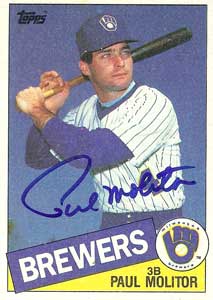
Growing up, my favorite baseball player was Paul Molitor. As a youngster, I remember heading to Kobs Field on the Michigan State campus to see the Gophers play the Spartans, and was awestruck at how Molitor destroyed MSU pitching. I remember looking at the free agent draft results in 1977 at my grandma’s house in Milwaukee and getting excited that the Brewers drafted “The Ignitor” with the 3rd pick. I made many a trip to County Stadium to watch Molitor and Robin Yount, Gorman Thomas, Ben Ogilvie, Sixto Lezcano, and Cecil Cooper lead the Brewers to many a successful season including a trip to the World Series in 1982, as well as cheering “Molly” on as he chased DiMaggio’s hitting streak culminating in 39 in 1987.
So, my mouth was agape when he decided to take the free agent route and sign with the Toronto Blue Jays in 1992. I was Shocked! Outraged! Aghast! He was a Milwaukee Brewer! He had always been a Milwaukee Brewer! He was my Milwaukee Brewer. How could he abandon all his fans and switch to another team? How could he betray my allegiance? It was nearly enough to make me give up watching baseball.

Fast forward 17 years, and the saga of Brett Favre, my favorite player on my favorite football team, the Green Bay Packers. Those familiar feelings rose up once again. While the circumstances may be slightly different, it was hard to see Favre put on another uniform, particularly that of the Purple and Gold (ugh!).
This week, I am yet again seeing another icon in my life think of changing jobs. This time, its Michigan State coach Tom Izzo. He is truly the face of Michigan State University. He turned a slightly better than average basketball program into the best in the country according to ESPN writer Andy Katz. Since 1999, Michigan State has won 6 Big Ten Titles, been to 7 Elite 8s, 6 Final Fours, and a National Championship. Now, he is possibly going to leave the MSU campus and take the head coaching job with the Cleveland Cavaliers.

Strangely, I am not so upset. People change jobs all the time, particularly in sports. Loyalty and long career tenures with one organization are not so commonplace anymore. I see the relationships I build with students diminish as students graduate and move on to the next chapter of their lives. Perhaps, it is because it hasn’t actually happened yet. He could still remain in East Lansing. Perhaps, I am thankful for the past 12 years under his watch.
Perhaps, it is simply just maturation.