Showing posts with label NBA. Show all posts
Kawhi Leonard, the #8ManRotation, and the #NBASummerLeague
by Matthew Stollak on Friday, July 5, 2019

Bringing the blog out from the mothballs for a couple of reasons.
First, check out this clip of the NBA whisperer, Adrian Wojnarowski chatting with Scott Van Pelt about the free agency status of the mercurial Kawhi Leonard. As of this writing, Kawhi still has not signed with an NBA team.
Why should you, the intrepid HR professional care about this story? As always, it covers everything that is the apotheosis of the #8ManRotation - the intersection of sports and HR. Recruiting. Talent. Compensation. Decision-making. Opportunity cost.
Here we have three franchises competing for one of the top five players in their field. Like any organization, they are trying to figure out what is going to attract him to come to their business over a competitor.
Complicating matters is the presence of the salary cap, the collective bargaining agreement, and the start of free agency. Kawhi Leonard can only receive the maximum, hence the three finalists for his services (Toronto, the Los Angeles Lakers, and the Los Angeles Clippers), cannot outbid each other for his services. So, compensation will not be the determining factor.
Further, free agents cannot begin signing contracts until Sunday, July 7 at 6 pm Eastern. Each of the three teams involved risk missing out on other available top talent by waiting on Kawhi to make his decision. The opportunity cost of waiting is huge.
Which brings us to the second reason for the post - the NBA Summer League in Las Vegas begins TODAY! For the past nine years, members of the 8 Man Rotation (Steve Boese, Kris Dunn, Lance Haun, Tim Sackett, and I) have made the trek to watch 9 hours of basketball a day, and opine on the HR implications. Think I am kidding? Check out this history of posts:
From Steve Boese:
1. Five quick 'Sports and HR' takes from the NBA Summer League
2. NBA Summer League Part 1 - The Relative Value of Talent
3. Observations from the NBA Summer League 2013
From Kris Dunn:
1. My Week at the NBA Summer League in Las Vegas, Part 1 (featuring Lessons on Talent)
2. My Week at the NBA Summer League in Las Vegas, Part 2 (featuring Lessons on Talent)
3. My 2016 Vegas Weekend at the NBA Summer League
4. Stuff the Capitalist (aka KD) Likes - The NBA Summer League
5. My Vegas Weekend with the 8 Man Rotation (featuring How Pro Hoops Misses On Talent...Just Like You
6. My Vegas Weekend via Instagram (featuring James Harden and Bro-Packs...)
From Lance Haun:
1. Finding "A" Talent is Overrated
From Tim Sackett:
1. Different Leaders for Different Situations
From Matt Stollak:
1. Quick Lessons from the 2014 NBA Summer League
2. Why #HR Should Care About the NBA Summer League
Look for posts from Steve, KD, Lance, and I in the coming weeks (Tim, as always will be the designated survivor).
- 2 comments • Category: #8manrotation, NBA, NBA Summer League, recognizing talent, recruiting
- Share on Twitter, Facebook, Delicious, Digg, Reddit


True Faith HR Replay: Why #HR Should Care About the NBA Summer League #8ManRotation
by Matthew Stollak on Tuesday, June 27, 2017
I'm heading to Las Vegas in two weeks with a few of the 8 Man Rotation folk (Kris Dunn, Steve Boese, Lance Haun)
to take in a couple days of NBA Summer League action. Worth revisiting
this July 2013 post. If you're in the area, come join us.
On July 13-16, I will join three of my colleagues behind the 8 Man Rotation
in Las Vegas (we always leave one behind to keep it going in case
something befalls the rest of us) for two to three days to catch some NBA Summer League action.
Why
do we want to head to the desert in summer time to spend 8-10 hours a
day in a gym watching exhibition basketball when those games don't
matter?
Because, in actuality, the games DO matter....for those playing. In his piece on Grantland, Steve McPherson describes what it is like for those involved:
These are guys who have worked their entire lives to be one of the 450 players in the top basketball league in the world. Guys who spent their whole lives being one of the best basketball players in any situation they ever found themselves in. And now it’s just the grind. They’re simply looking for their shot.
The ones hoping for that shot are almost universally flawed in one way or another: undersized or stuck between positions; not good enough at one specific thing to be useful to a team; dogged by problems we can’t even see, the kind of stuff many of us carry around.........
But for these players — who are among the top one or two percent of basketball players in the world — it’s their big chance. Not to become something they’re not, but to see their years of work turn them into what they’ve always been striving toward.
Those playing over these few days in Orlando and in Las Vegas are no different than the applicants to your organization. They're polishing their resumes, taking your work sample test, engaging in your role play or simulation, trying to impress you enough to take a chance on them.
For us watching, it will be passing entertainment...but for those involved, it will be all too real, with stakes that truly matter to them.
- Leave your comment • Category: #8manrotaion, #NBASummerLeague, NBA, talent
- Share on Twitter, Facebook, Delicious, Digg, Reddit

Its long been mantra that great employees want to work with other great employees. The organization can only be better when great employees see others putting out quality effort. In "First, Break All The Rules," Marcus Buckingham wrote that one of the critical 12 questions that measures the strength of an organization is "Are my co-workers committed to doing quality work?"
Interesting news, then, from the NBA, as the star of the Chicago Bulls is shying away from selling the organization to prospective players - in particular, talented free agent Carmelo Anthony. According to Yahoo Sports,
The Chicago Bulls are expected to pursue Carmelo Anthony in free agency. They just shouldn't expect Derrick Rose to participate in the recruiting.
Rose told Yahoo Sports on Sunday that he doesn't plan to recruit Anthony – or any free agent, for that matter – even though he likes Anthony's game and thinks they can play alongside each other.
Rose's reason is simple: He said it's "not his job."
"My thing is if they want to come, they can come," Rose said.
The goal of every player and team is to win that world championship (though some would rather make that max contract). Each player should be looking at how they could make their team better. Joakim Noah, Derrick Rose's teammate, has been doing everything possible to get Carmelo to come to Chicago:
According to several sources, including a teammate, Noah's All-Star Weekend “conversation'' with New York Knicks standout Carmelo Anthony didn't end in New Orleans. They had discussions via text the rest of the season, including the day after the Bulls were eliminated in the playoffs by the Washington Wizards.
“I was kidding Jo that they were boys now,'' a source said in a phone interview Friday. “ ‘Well, get your boy to come to Chicago.' ''
Sources said Noah has been in Anthony's ear as often as possible, and he has told other Bulls to push hard for Anthony this summer. But there is one condition: Backup big man Taj Gibson can't be sacrificed.
So, what is the obligation of your superstar to sell your organization to prospective candidates? Does he or she have any responsibility, particular when fellow employees are making a strong push as well?
......................................................................
Its less than 2 weeks until the start of the NBA Summer League, and the 8 Man Rotation is looking forward to its annual trip to Las Vegas, June 17-20. If you're interested in joining us, let me know.
- One comment • Category: #8manrotation, Derrick Rose, Joakim Noah, NBA, NBA Summer League
- Share on Twitter, Facebook, Delicious, Digg, Reddit

Better late than never, it is the 2013 Season of the 8 Man Rotation - your compendium of all things sports and human resources. The team of Steve Boese, Kris Dunn, Lance Haun, Tim Sackett and yours truly have once again assembled to bring you all the highlights from 2013 in the sports world that impacted or is related to human resources.
What is the 8 Man Rotation? From the 2010 season, "In basketball parlance, it refers to the five starters and three players off the bench who play the primary amount of minutes during a game. Given that most basketball rosters contain 12 or more players, the coach has decided that the combination of these 8 players provides the team with the best opportunity to win. Team chemistry and production are at its maximum."
This edition highlights such chemistry and production with 60+ posts covering Manti Te'o, Earl Monroe, Triple H, and LeBron James. Find out what is meant by the phrase, "Ball Don't Lie." Get a detailed look at the NBA Summer League. In addition, you get a foreword from Saints superfan, Robin Schooling.
So, download it now, and read it in parts, or in one piece all weekend. Bring it on the plane for some light reading on your trip to Utah for Hirevue's Digital Disruption or Orlando for SHRM Annual. It also makes a great Father's Day gift!
As always, you can get the 2013 Season, as well as the 3 previous seasons at the8manrotation.com.
- 2 comments • Category: #8manrotation, #HR, Kris Dunn, Lance Haun, NBA, Robin Schooling, Sports, Steve Boese, Tim Sackett
- Share on Twitter, Facebook, Delicious, Digg, Reddit
Monitoring Employees? Big Data? The NBA Has You Beat
by Matthew Stollak on Thursday, September 5, 2013

Well, the NBA is taking employee monitoring to a whole new level.
They are installing data-tracking cameras in all 29 arenas that will enable them to gather intriguing information.
If you are a referee, you will be monitored to see whether you are getting in position as well as making the right call:
one reason the league acted fast was to immediately enhance its ability to monitor referees — always a touchy subject. The cameras represent the most precise way to grade the three on-court officials based on how consistently and early they get into the league’s three set positions — called “lead,” “slot,” and “trail” — and whether they make appropriate calls from those positions based on their exact sight lines. This is the next stage in seeing which officials are the best, and thus deserving of high-stakes assignments, and in quantifying that in ways that are hard to dispute.
The league has already started using the cameras to check on the enforcement of defensive three-second violations out of concern that defensive players routinely break the rule by lingering in the lane too long. (The results of said studies are inconclusive so far, say several sources familiar with the inquiry.)
What about player performance? In "Airplane," when Kareem Abdul-Jabbar (as Roger Murdock) was questioned on his effort, he said,
"LISTEN, KID! I've been hearing that crap ever since I was at UCLA. I'm out there busting my buns every night. Tell your old man to drag Walton and Lanier up and down the court for 48 minutes"
Now, with the installation of the data-tracking cameras, NBA teams can now measure work-related hustle:
Teams can pay up to $40,000 extra to purchase (among other goodies) software that helps track a player’s physical exertion. The in-game cameras represent one piece of that. They can tell you how fast a player runs, how often he accelerates on cuts, how often those accelerations end with him reaching top speed, and the height of a player’s release point on jump shots. Some players recovering from injury, including Ricky Rubio last season, have taken significant game time to get back to their previous speed and fitness baselines. And an injury to one star, Manu Ginobili early in the 2011-12 season, resulted in the other San Antonio starters exerting more physical effort with a standstill shooter (Danny Green) in Ginobili’s place.
The other pieces, and perhaps the most important ones in determining a player’s condition, come outside those 82 games and require the use of other forms of technology: sleep and heart-rate monitors, GPS devices and accelerometers players can wear during practice, and the careful tracking of weightlifting, diet, and other day-to-day stuff. Put all that data together, and you can get a fairly complete picture of a player’s condition, and of how indicators of his condition — running speed, jumping ability, etc. — change over the course of a season. “This is where you can start to measure fatigue,” says Brian Kopp, executive vice-president at STATS.
A revealing nugget: Teams really want the SportVU cameras to monitor their practices, Kopp says. That’s difficult, since most teams practice somewhere other than their game arenas. Some coaches and GMs might want the practice data simply to check on which players work hard, and which loaf.
But others will want it to change the very concept of practice. How much practice time do teams really need? And how taxing should those practices be? How should that change during the season? There are higher-ups around the league who are ready to radically rethink these things, provided the next-level data indicates they should.
And, think of the impact these measures can have on contract negotiations:
So imagine a player entering the final year of his rookie-scale contract and his agent beginning contract talks only to hear a team official open with something like, “Our camera data shows you really don’t hustle in the fourth quarter. Your running speed slows down. You just stand around instead of going for rebounds. These are some of the reasons we are offering you only $7 million per year.”
Wouldn’t that agent want to at least cross-check that data, to make sure it’s not B.S.? The players union has already started the fight for access to that data. “All we want is to make sure access is available,” says Ron Klempner, the union’s executive director. “If teams are forming impressions about players that players are not in position to defend, we want to make sure everyone is operating on an even scale.”
New technologies transforming how the NBA does business. Even Kareem Abdul-Jabbar should be impressed.
- 2 comments • Category: #8manrotation, monitoring, NBA
- Share on Twitter, Facebook, Delicious, Digg, Reddit

On Thursday, I will join three of my colleagues behind the 8 Man Rotation in Las Vegas (we always leave one behind to keep it going in case something befalls the rest of us) for two to three days to catch some NBA Summer League action.
Why do we want to head to the desert in summer time to spend 8-10 hours a day in a gym watching exhibition basketball when those games don't matter?
Because, in actuality, the games DO matter....for those playing. In his piece on Grantland, Steve McPherson describes what it is like for those involved:
These are guys who have worked their entire lives to be one of the 450 players in the top basketball league in the world. Guys who spent their whole lives being one of the best basketball players in any situation they ever found themselves in. And now it’s just the grind. They’re simply looking for their shot.
The ones hoping for that shot are almost universally flawed in one way or another: undersized or stuck between positions; not good enough at one specific thing to be useful to a team; dogged by problems we can’t even see, the kind of stuff many of us carry around.........
But for these players — who are among the top one or two percent of basketball players in the world — it’s their big chance. Not to become something they’re not, but to see their years of work turn them into what they’ve always been striving toward.
Those playing over these few days in Orlando and in Las Vegas are no different than the applicants to your organization. They're polishing their resumes, taking your work sample test, engaging in your role play or simulation, trying to impress you enough to take a chance on them.
For us watching, it will be passing entertainment...but for those involved, it will be all too real, with stakes that truly matter to them.
- 2 comments • Category: #8manrotation, NBA, talent
- Share on Twitter, Facebook, Delicious, Digg, Reddit
Recruiting When Money is NOT the Object - The Case of Dwight Howard
by Matthew Stollak on Tuesday, July 2, 2013
 |
| Time for an #8ManRotation Post |
For the most part, firms compete for talent on the basis of salary - if you pay more than the next guy, you usually win out. When recruiting ace pitcher C.C. Sabathia, the New York Yankees made a major splash by offering $40 million more than other teams.
But, what do you do when money is not the centerpiece of the discussion? With free agency bidding opening yesterday, take the current recruitment of mercurial NBA center Dwight Howard. Unlike most organizations, the NBA has a salary cap with a maximum contract that can be offered. In other words, all 30 NBA teams could offer Howard the same salary, and not a dollar more.
With that in mind, what can a team do to make their case?
- Is the boss someone you want to work for? The Los Angeles Clippers recently brought in coach Doc Rivers from the Boston Celtics in order to retain free agent star guard Chris Paul.
- Can you reach the pinnacle of success in a short period of time? Obviously, the goal for any NBA team is to win the Championship....does your team provide the best opportunity to do so in the next 2-4 years?
- Can you show that the talent is truly wanted? If you are the Los Angeles Lakers, do you put up billboards pleading for the talent to stay? Do you photoshop your employee's image over iconic locations in your city?
- Are there other ways to make those salary dollars go further? The Houston Rockets might be attractive to Howard, as, unlike California, the state of Texas has no state income tax. Or, if you're Dallas, you have a restaurant willing to offer free chicken fingers for life (nearly $200,000 in food that Howard would not have to pay).
- Leave your comment • Category: #8manrotation, Clippers, Dwight Howard, Lakers, Mavericks, NBA, recruiting, Rockets
- Share on Twitter, Facebook, Delicious, Digg, Reddit

Over the past week, two major events in talent management occurred in the NFL and NBA
Sunday, April 28 was the deadline for, basically, those basketball players who still have at least one year of college eligibility remaining to declare for the NBA draft. Similarly, this past weekend saw the 7 round NFL draft.
Unlike most organizations, where employers can choose to hire whomever they want at whatever rate of pay they want, and applicants can choose to apply at organizations where they want to work, the NBA and NFL have a restricted model of employment. Instead of choosing one's employer, candidates must declare they are ready to turn from amateur athlete into a professional, and are subject to the whims of the professional teams if they are to be selected. However, there is a risk involved, particularly for the player - once you make that declaration, in most instances, you cannot return to the amateur ranks.
This past weekend, 21 out of 73 (28.8%) early NFL entrants went undrafted. This was only a slight improvement over 2012, where 20 out of 64 (31.3%) were not chosen. The NFL has put in place a draft advisory committee to give advice about where players may potentially be drafted, but, in many instances, the advice is either misguided or goes unheeded.
Currently, few (if any) prospective NFL players take advantage of NCAA rule 12.2.4.2.3:
In football, an enrolled student-athlete (as opposed to a prospective student-athlete) may enter the National Football League draft one time during his collegiate career without jeopardizing eligibility in that sport, provided the student-athlete is not drafted by any team in that league and the student-athlete declares his intention to resume intercollegiate participation within 72 hours following the National Football League draft declaration date. The student-athlete's declaration of intent shall be in writing to the institution's director of athletics. (Adopted: 10/31/02, Revised: 4/14/03, 12/15/06)The NBA draft rules are just as convoluted. The NCAA’s rule is that any player that has entered the NBA Draft with eligibility remaining and that hasn’t signed with an agent must withdraw their name from consideration by April 28th or lose their collegiate eligibility. Once that April 28th date passes, you can choose not to be drafted, but you cannot return to college and play. Further, the NBA has instituted an age rule regarding eligibility:
- All drafted players must be at least 19 years old during the calendar year of the draft. To determine whether a player is eligible for a given year's draft, subtract 19 from the year of the draft. If the player was born during or before that year, he is eligible.
- Any player who is not an "international player", as defined in the CBA, must be at least one year removed from the graduation of his high school class.
Its understand why the rules exist....the NBA players union want to protect veteran players, and a greater influx of younger talent means less potential slots for older ones. For college coaches, they want to better be able to project what their roster will look like for the upcoming year and plan for scholarships.
However, why should the player suffer with regard to bad advice.
So, here is what I propose:
1. Eliminate all restrictions on who a team can draft.
If an NBA or NFL team with the first pick wants to draft a high school player or one with college eligibility, let them. That player can choose to sign with the team or not.
2. However, the teams retains all rights to any player drafted only in the first round until their college eligibility is used up.
By maintaining rights to that player, even for years on end, they are able to hold on to a valuable asset. That player can sign with the team, or they can also trade him away, if they are unable to sign him. It would also be interesting to see some teams drafting later in the first round gamble on a player who may not turn pro initially.
3. Eliminate the transfer rule of a player sitting out a year if he transfers.
Players might have signed with a school expecting minutes to be available to play based on a player likely entering the draft early. Now, if a player doesn't go pro, he has the opportunity to play elsewhere without having to sit out a year. Further, coaches are able to change schools without having to sit out a year. The same luxury should be extended to players.
In sum, most players turn pro early because they anticipate being picked in the first round of the draft where money is guaranteed. Further, it is extremely unlikely that any player chosen in the first 15 picks is going to turn down the money available to him. Finally, players who did not get chosen in the round they expected can return to school without being penalized for poor advice.
The Academic Version of "Unemployed Need Not Apply"
by Matthew Stollak on Monday, September 24, 2012
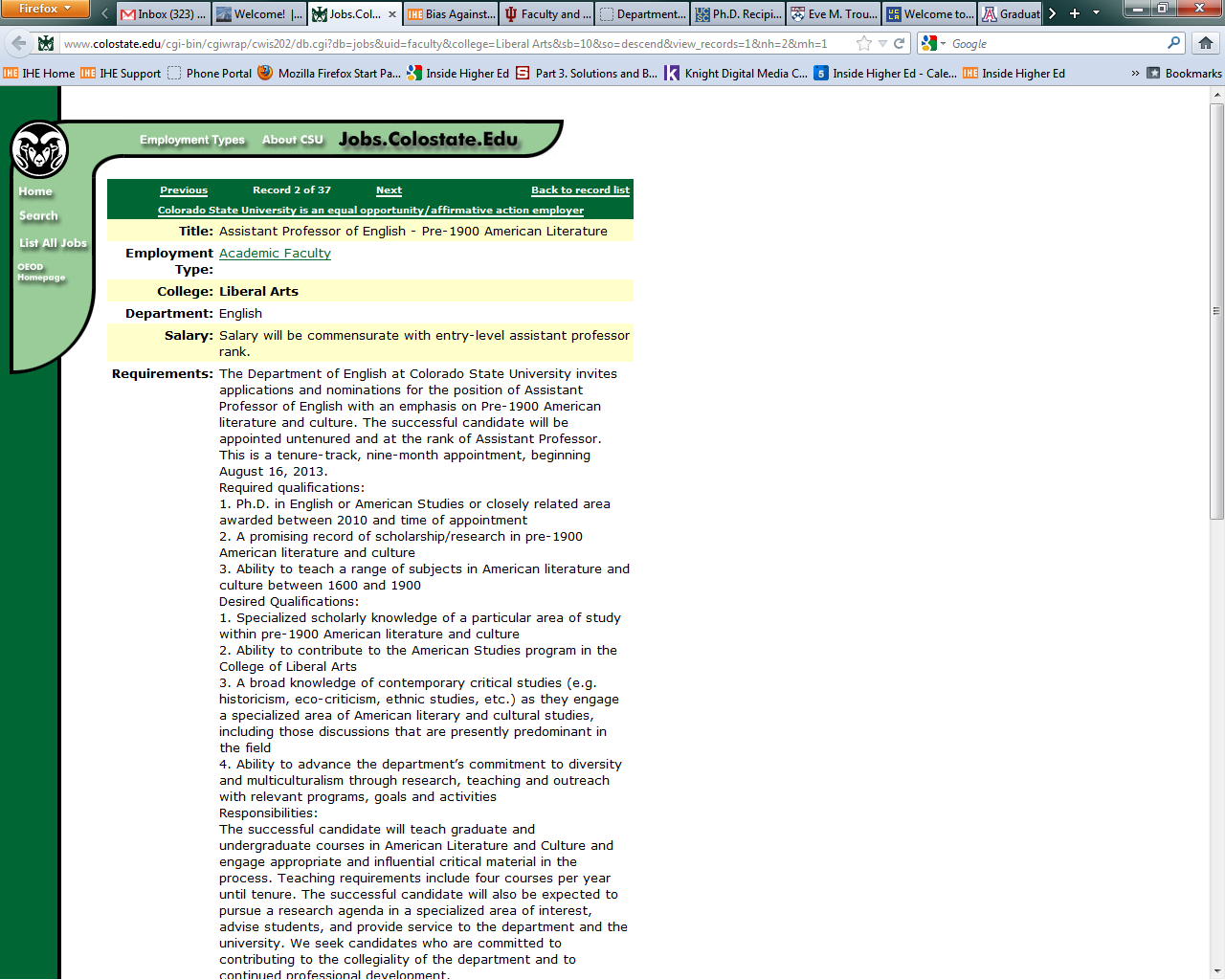
Check out this recent ad for a Humanities position at Colorado State University. Focus on the following:
Required qualifications:
1. Ph.D. in English or American Studies or closely related area awarded between 2010 and time of appointment.
2. A promising record of scholarship/research in pre-1900 American literature and culture.
3. Ability to teach a range of subjects in American literature and culture between 1600 and 1900.
A similar recent job posting at Harvard University for an Assistant Professor of Comparative Literature, “Applicants must have received the PhD or equivalent degree in the past three years (2009 or later), or show clear evidence of planned receipt of the degree by the beginning of employment.”
What do you notice? Go ahead...take a minute....
.
.
.
.
.
.
.
.
Well, items #2 and #3 do not seem out of the ordinary - these seem like reasonable requirements for the position. However, #1 for CSU, as well as the Harvard ad, is interesting and has ginned up a little controversy (note...both ads have changed).
Much like we've seen in the private sector, academics were not immune to the vagaries of the economy. If you completed your Ph.D., and entered the job market in 2007, 2008, or 2009, you may have had difficulty finding a tenure track academic position. Now, with ads such as those filed above, we have the academic equivalent of "unemployed need not apply."
Are there reasons to narrow the candidate search in such a manner? It could be economic. Someone with 3 or less years of academic experience will take longer to apply for tenure and promotion, and the accompanying bump in salary. With an average salary increase of 1.4% from 2009-2010 to 2010-2011, earning tenure and promotion is often the only way for professors to see a significant bump in compensation. As a result, delaying the promotion decision can positively affect the bottom line for colleges and universities.
Another reason may be that CSU or Harvard might already have an internal candidate, such as a visiting assistant professor, and are trying to keep the applicant pool small.
A third reason might be similar to the NBA draft, where a team would rather take a chance on a college sophomore's "tremendous upside potential," than a college senior's "experience" that's good, but not great. In this instance, a college might prefer the freshly minted graduate, than a less malleable individual with a couple of academic years under his or her belt.
However, the start of such a trend is worrisome for an already difficult job market, where it might take as many as 3 years to land a tenure track position. One might have spent two or three years serving as an adjunct while trying to publish an article or two. I might be a promising academic who might have had an illness, or family issues (such as caring for a sick parent), or served in the military that might adjust one's tenure clock. Or, I might have found a tenure track position, and simply want to relocate to another area of the country.
It also affects the time one spends in graduate school. Future academicians may delay the time that they finish so they will have a more established publication record, to, subsequently, become more competitive in the job market.
When I entered the academic job market in 1994, supply of labor exceeded the number of jobs available, and it took 6 months to find a visiting position. When I finally found a tenure track position, and built up a number of years of experience, I wanted to find a job a little closer to my parents. Such mobility may be a thing of the past.
- Leave your comment • Category: #8manrotation, Academia, job posting, NBA
- Share on Twitter, Facebook, Delicious, Digg, Reddit