On Thursday, I will join three of my colleagues behind the 8 Man Rotation in Las Vegas (we always leave one behind to keep it going in case something befalls the rest of us) for two to three days to catch some NBA Summer League action.
Why do we want to head to the desert in summer time to spend 8-10 hours a day in a gym watching exhibition basketball when those games don't matter?
Because, in actuality, the games DO matter....for those playing. In his piece on Grantland, Steve McPherson describes what it is like for those involved:
These are guys who have worked their entire lives to be one of the 450 players in the top basketball league in the world. Guys who spent their whole lives being one of the best basketball players in any situation they ever found themselves in. And now it’s just the grind. They’re simply looking for their shot.
The ones hoping for that shot are almost universally flawed in one way or another: undersized or stuck between positions; not good enough at one specific thing to be useful to a team; dogged by problems we can’t even see, the kind of stuff many of us carry around.........
But for these players — who are among the top one or two percent of basketball players in the world — it’s their big chance. Not to become something they’re not, but to see their years of work turn them into what they’ve always been striving toward.
Those playing over these few days in Orlando and in Las Vegas are no different than the applicants to your organization. They're polishing their resumes, taking your work sample test, engaging in your role play or simulation, trying to impress you enough to take a chance on them.
For us watching, it will be passing entertainment...but for those involved, it will be all too real, with stakes that truly matter to them.
- 2 comments • Category: #8manrotation, NBA, talent
- Share on Twitter, Facebook, Delicious, Digg, Reddit


In late April, Robert Galbraith published his first novel - a mystery called "The Cuckoo's Calling" - to rave reviews but relatively few purchases. Yesterday, Robert Galbraith's book was languishing at 4,709 on Amazon's bestseller list with 1500 sales. Now, the book's sitting at number 1; a 156,866% sales increase in 1 day.
What was responsible for such a dramatic change in fortune?

Robert Galbraith was revealed to be the psuedonym of a little known author named J.K. Rowling.
How often did people pass by the book at their local Barnes & Noble (they still exist, right?) and not give it a second glance simply because of the name of the author?
And, how often do we in HR look over a resume or judge performance simply by looking at the name of the applicant or employee?
It's an all to familiar lesson - you can't judge a book by its cover - literally.
- Leave your comment • Category: first impression error, J.K. Rowling, performance, resume, Robert Galbraith
- Share on Twitter, Facebook, Delicious, Digg, Reddit
"Repeat after me: "Not everyone is going to like me and its not my job to make sure they do."
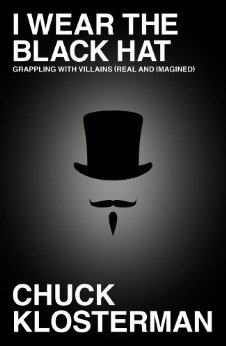
As a fan of Chuck Klosterman's writings, I had to pick up "I Wear The Black Hat: Grappling With Villains (Real and Imagined)," a fascinating series of essays on the notion of evil and villainy. As he posits in the premise, "Why would anyone want to be evil?" What separates a villain, from a crook or a bad boy?
In Star Wars, Klosterman argues as a youth are we drawn to Luke Skywalker (who's pure good), we gravitate toward Han Solo (who is a good bad boy), but find the only intriguing figure in adulthood is Darth Vader?
In Purple Rain, we are supposed to root for the pure, suffering Prince, but find ourselves more interested in the confident Morris Day (Why? narcissicism scans as charisma).
Why do we find ourselves empathizing with Tony Soprano or Walter White?
What makes Machiavelli truly Machiavellian? According to Klosterman,
The Prince can be read like a self-help book for someone who openly aspires to be depraved: This is what's important to believe, this is how the powerful should act in public, this is how you need to behave in private, et cetera. It's a clinical dissection of how to be tyrannical. Whether Machiavelli believed these things is beside the point - what matters is that he presented them as pure stratagem. It was not an emotional reaction to a specific circumstance; it was a calculated design for life, usable by anyone, applicable anywhere. He turned an autocratic template into entertainment. This is what makes Machiavelli culturally unlikeable. It make him cold. The mere fact that he could conceive of these strategies - even if he'd never have used them himself - is what makes him sinister forever.
And, this leads to Klosterman's premise for the book:
In any situation, the villain is the person who knows the most but cares the least.
Machiavelli "didn't need to commit evil acts. He didn't need to be evil. That was just how his mind naturally worked, and that's what discomforts people."
And, this is why HR is often perceived as the villain.
In most employee relations issues, the HR representative should be the person who knows the most. He or she understands the HR body of knowledge. He or she should be most familiar with the appropriate rules and regulations.
However, by always looking out for the best interests of the organization, by being objective in its approach, the HR representative can be perceived by the employee as dispassionate or uncaring.
Hence, HR is the villain!
- Leave your comment • Category: Chuck Klosterman, Evil, Machiavelli., Prince, Star Wars, villain
- Share on Twitter, Facebook, Delicious, Digg, Reddit

I was taken to task by a reader regarding my use of LinkedIn to examine the educational background of the HuffPost Top 100 Most Social HR Experts on Twitter. Her argument is that LinkedIn is a glitchy marketing tool, that shouldn't be confused with a resume.
So, it got me wondering...if not LinkedIn, where can I find the evidence of the expertise and background of the HR leaders of today?
Combing the list and perusing the many HR blogs and personal websites out there, one of the things I have noticed is how few have the author's resume (or a link to one) detailing employment history, skills, educational background, etc. There might be a bio, some background info, and a link to LinkedIn to connect, but rarely is there information demonstrating their bonafides.
Why might that be?
- Despite the reader's contention above, has LinkedIn replaced the traditional resume for most, and individuals should be directed there to see the details?
- Personal preference?
- The author hasn't updated the resume in quite awhile?
Leave your thoughts below.
- 11 comments • Category: employment history, LinkedIn, resume
- Share on Twitter, Facebook, Delicious, Digg, Reddit

In the wake of the HuffPost Top 100 Most Social HR Experts list, and the significant number on the list who do not have HR certification, was a comment made by one of those top 100 members:
As a recruiting practitioner I really see no value personally or professionally in being a SHRM member or gaining a certificate. Unless someone could give me a really good reason to the contrary.
Certainly, if one goes to the Human Resource Certification Institute (HRCI) website, the benefits are laid out:
- show you know the most current principles and core practices of HR management
- become more marketable when you compete for top HR positions
- raise your professional confidence among your staff and your peers
- certified HR professionals earn 13.2% higher salary than their non-certified peers
- organizations with certified HR professionals have 12.2% greater retention of high performing employees
- organizations with certified HR professionals have 14.6% less EEOC complaints than organizations led by non-certified HR leaders
With the increasing popularity of the SHRM certification program as well as the proliferation of other similar certifications, it is time to determine (1) what certification measures and how well it does it; and (2) what difference having certification makes to individuals, to organizations, and to the HR profession.
To answer the above, and as the title of their article suggests, Lengnick-Hall and Aguinis create a multi-level framework for research shown in the figure below:

The figure depicts three important elements: (a) time, (b) macro-level effects, and (c) micro-level effects. First, the starting time begins with the implementation of the organizational staffing practice of using HR certification as a selection tool. This staffing practice represents a contextual (top-down) effect on the organization's individual KSAOs because all potential HR professional employees will be recruited using the HR certification predictor. HR certification is used as a selection tool because it measures human resource management knowledge
Accompanying the figure are 14 testable propositions, including:
- Proposition 2: Individuals with undergraduate or master's degrees in human resource management or related disciplines will not benefit as much (increased hiring probability, higher salaries, and faster promotion rates) from an HR certification compared to individuals without such degrees
- Proposition 3: As assessed by longitudinal research, we predict that individuals with undergraduate or master's degrees in human resource management or master's degrees in business administration will obtain more C-suite positions and perform more effectively in these roles compared to individuals who have certifications such as SHRM's PHR or SPHR
- Proposition 4: Using HR certification as a selection tool will be positively associated to individuals' HR management knowledge
- Proposition 5: Certified HR professionals will perform better (i.e. effectively diagnose and resolve HR problems, design and implement HR programs aligned with organizational objectives, etc.) on the job than do non-certified HR professionals
- Proposition 6: A greater proportion of certified HR professionals who have shared HR knowledge in an HR department will lead to higher unit-level performance
- Proposition 11: A greater proportion of certified HR professionals in the HR function will lead to more favorable perceptions by multiple constituents regarding the value-added contribution of the HR function in the organization and thereby enhance HR department reputation
- Proposition 13: A greater proportion of certified HR professionals in an HR department will lead to higher HR department effectiveness
Certainly, answering the propositions listed will be a difficult process, and perhaps this is why such research is lacking. As Cohen (2012) notes in the same issue:
In order to test Proposition 2, data would need to be collected from a single huge organization with a large enough population of HR professionals who are covered by the same compensation plan to test the proposition. You would need archival data of salary trends, certification status, educational achievements, promotions, performance data, and so forth to comparatively test for the differences in salary and advancement. A study of just HR professionals, outside of the archival factors mentioned many not provide accurate or generalizable information. Titles may or may not be comparable across organizations so unless the data comes from a single organization where title, responsibility and other variables can be controlled, the results may not reveal anything meaningful.
Nonetheless, these questions are of critical importance to the profession, and I echo Aguinis and Lengnick-Hall's (2012) challenge to the SHRM Foundation: Issue a call for proposals for empirical research on the value of HR certification.
Why the @huffpostbiz Top 100 Social #HR Experts on Twitter Should Be a Wake-Up Call to #SHRM
by Matthew Stollak on Wednesday, July 3, 2013

However, if I am the Society for Human Resource Management, I'd be very worried about this list.
Why?
I went through the LinkedIn profiles of all 100 individuals and found:
- Only 21 individuals had listed they had earned PHR or SPHR certification (none listed GPHR). This number could be higher, but some either chose not to list it, or they may have let certification lapse.
- Less than 60 had a formal business education (i.e., a BBA or post-graduate degree in a business-related field). Some only listed their college, but did not list their educational background. Others did not have education as part of their LinkedIn profile.
- Of that 60 or so, less than 25 concentrated in human resources as part of their undergraduate or graduate education.
- Is pursuit of certification perceived as valuable? If a significant portion of those who are perceived as being knowledgeable on the field of HR (or at least a major subset of the field) do not possess certification from SHRM, will some choose not to pursue it as well, as they do not see it as necessary to succeed in the industry?
- Barriers to entry in the field of HR continue to be low. Again, many of the individuals on this list have demonstrated through on-the-job experience and success that they deserve to be lauded. But, it should concern SHRM that many apparently do not need a HR education to be successful in HR.
- The need to embrace social and its impact on membership. SHRM has done a wonderful job over the past couple of years of working with many on this list. Over 50 on the list served on the social media team at the 2013 SHRM Annual Conference in Chicago. However, with many on the list having little to no affiliation with SHRM, will some HR professionals wonder why they should join SHRM when others are possibly providing valuable information for free?
- 7 comments • Category: certification, HR Education, HRCI, Huff Post, SHRM
- Share on Twitter, Facebook, Delicious, Digg, Reddit

Given it is the eve of the U.S. Independence Day, nothing is more fitting than a celebration....in this case a celebration of great HR content.
So what makes a great July 4th celebration?
Travel - Whether to visit family or friends, many will take the July 4th break to head out on the open road. So, it is fitting that Naomi Bloom shares the great HRM she experienced in her recent travels from Istanbul to Vienna (Part 1, Part 2, Part 3).
Music - As background to the cookout or conversation, or to accompanying the explosions overhead, music plays an important role to any July 4th celebration. Mervyn Dinnen provides some choice tunes with his top 6 albums of 2013 thus far. Amit Bhagria shares his Job Description of a Karaoke Artiste.
Movies - For some, July 4th provides an opportunity for some to catch up with the latest films at the cineplex. With that in mind, Robin Schooling informs us that "Even 007 Can't Work Alone."
Guests - Usually, any celebrating is done with others. But, unfortunately, it doesn't always work out. Shauna Moerke tells us "How To Connect in Non-Creepy Ways on Social Media." Mike Haberman suggests "7 Reasons You Have Toxic Employees."
Games - No July 4th celebration is complete with a little gameplay. At the Dovetail Software blog, Dwane Lay highlights with his wrapup of the SHRM13 kickball game and its impact to raise support for No Kid Hungry. Of course, you need great players to make a successful game, and at the Teleos Consulting blog, Joan Kofodimos suggests that we need to banish the cult of the A-B-C player. Similarly, Susan Heathfield tells us to "Do Powerful Internal Training." But, if these players come together, Julie Winkle Giulioni wonders are they a team, a group, or a train wreck? And, if you don't play as well as expected, John Hunter ponders "What is the Explanation Going to Be if this Attempt Fails?"
Food - Whether it be a picnic, cookout, or barbecue, food is critical for any successful July 4th enjoyment. In this case, there is plenty of food for thought; just chew on the following:
- At the Tribe HR blog, Katy Innes shares 7 Goal and Management Tips for New Supervisors
- At the Four Groups blog, Michael Folkman wants us to Rethink the War on Talent
- At the Inflexion Advisors blog, Mark Stelzner thinks about HR innovation and suggests we might "Maintain Optimism and Fresh Eyes"
- At the Canadian HR Reporter, Stuart Rudner share some tips on hiring and firing.
- At the Great Leadership blog, Dan McCarthy tells us How to Overcome the 3 Barriers to Leadership Development
- From the Human Capital Strategy Blog of the Rainmaker Group, Chris Young shares 7 Things I Wish I Knew When Founding This Company
- The Godfather Steve Browne shares 5 New Ideas he gleaned from the 2013 SHRM Annual Conference
- At the Toolbox for HR, Ian Welsh queries, "What Kind of Passion is Best At Work?"
- At the Humor That Works blog, Andrew Tarvin has Advice for People in Job Transition
- At Welcome to the Occcupation, Paul Smith wants your Subscription to HR Leadership
- At the HR Introvert, Tim Gardner tells us Why Everyone Should Have A PIP
- At UpstartHR, Ben Eubanks suggests "Maintaining Your Culture As You Grow."
Fireworks - The end of the July 4th evening is typically capped with a fireworks explosion. Hence, it would be a shame if there was no big bangs. Karin Hurt shares "10 Ways to Zap Energy and Squash Enthusiasm."
This concludes the July 3rd edition of the Carnival of HR. Be sure to head over to mentoring Mullarkey for the July 17th edition.
- Leave your comment • Category: Carnival of HR
- Share on Twitter, Facebook, Delicious, Digg, Reddit